A bedroom has one job description with two clauses: hold your things, and let you sleep. Most bedrooms fail on the first clause and blame the second. The floor fills, the surfaces silt up, and the room where you are supposed to rest becomes the room where everything else went.
We build the quiet furniture that fixes this, nightstands, dressers, bed frames and the storage around them, and the advice we give buyers one letter at a time is gathered here: how to size a nightstand honestly, what a fabric dresser does and does not do well, why bed height is secretly a storage decision, and the one safety step, anchoring, that we consider part of assembly rather than an optional extra.
The nightstand is a system, not a table
Start beside the bed, because that is where bedroom clutter is born. The pile on the nightstand is not a discipline failure. It is a capacity failure: a flat top with no drawers can only hold things by stacking them, so it does.
A working nightstand needs three layers. A top for the current items, the glass, the phone, the book in progress. A drawer for the small private things that otherwise colonize the top, chargers, lip balm, the notebook. And a shelf or second drawer for the overflow that would otherwise migrate to the floor. Our fabric-drawer nightstands follow exactly this layout, and the tall four-drawer version is the same idea stretched vertically for rooms where floor space is the scarce resource.
Size it by the mattress, not by the catalog photograph. The useful top sits within a couple of inches of mattress height, reachable without sitting up, and the footprint should stay inside roughly 16 by 12 inches in a small room so the walking lane past the bed survives. If two people share the bed, two small nightstands beat one large one every time, which is half the reason ours sell as sets of two. The other half is symmetry, which is free and makes the room look finished.
A charging station built into the nightstand earns its place in one specific case: when the alternative is a power strip on the floor. Cables that live inside furniture do not tangle, do not gather dust and do not end up under a bare foot at midnight.
What fabric drawers are honestly for
Our most popular bedroom pieces run on fabric drawers in steel frames, and buyers deserve the honest version of what that construction trades.
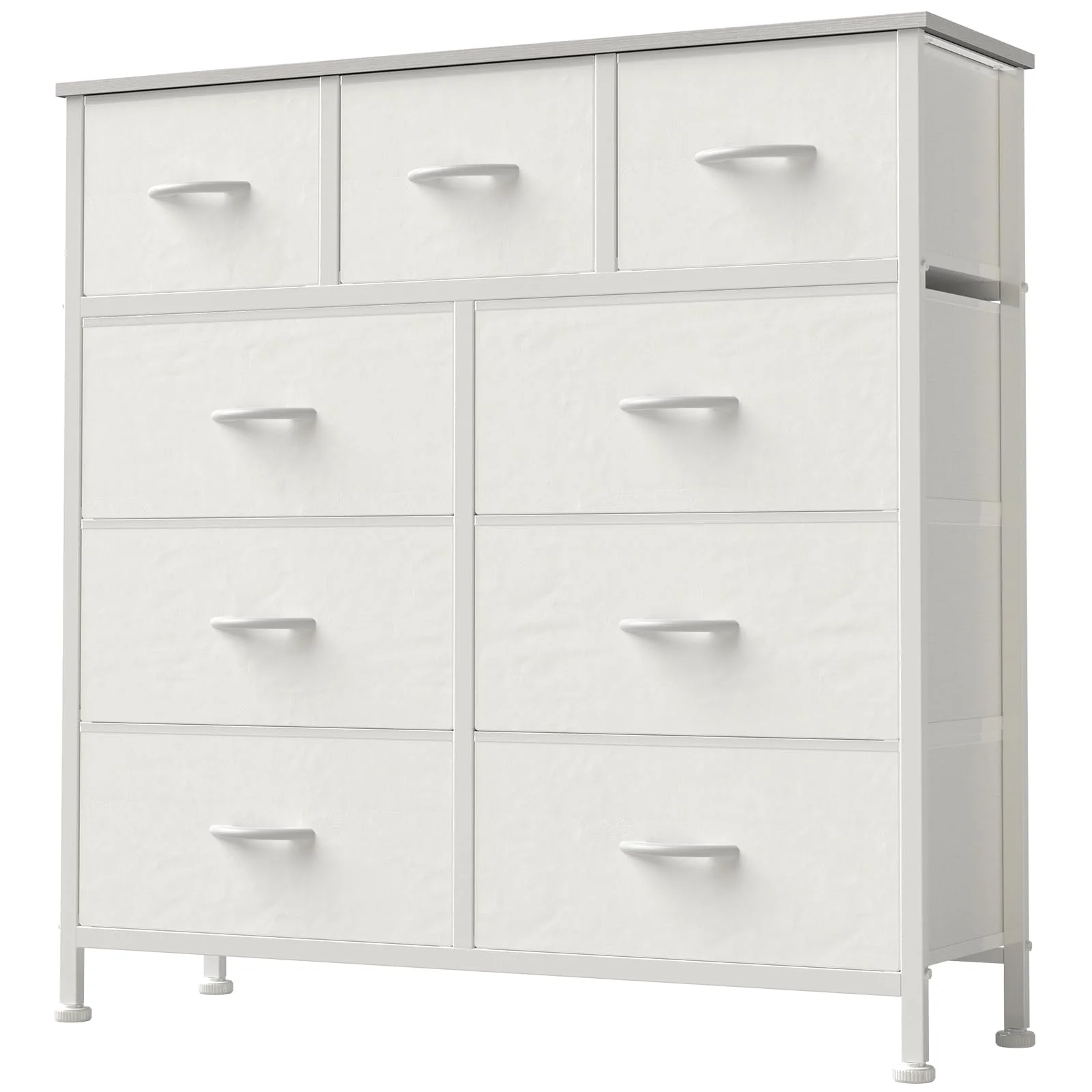
Fabric-drawer dressers are light, inexpensive, and assemble in under an hour with the included tool. The drawers themselves are removable bins, which turns laundry day into a transport job: carry the drawer to the dryer, fill it, slot it back. The steel frame carries the load, the wood top takes the lamp and the tray, and the whole piece moves between apartments without a truck or a toolkit. For a first bedroom, a kid's room, a guest room or a closet interior, this is the right tool.
What they are not is heirloom casework. Fabric bins do not lock, do not fully seal against dust, and the frame's stated top-surface limit deserves respect, ours states a 44 lb rating on the nightstand top, and that is where the television does not go. A nine-drawer fabric dresser swallows an entire wardrobe for less than the price of one wooden drawer chest, and it does so honestly, as light equipment rather than furniture your grandchildren will fight over.
| Bedroom storage | Best at | Watch out for |
|---|---|---|
| Fabric-drawer nightstand | Bedside layers, small rooms | Top-surface weight limits |
| 9-drawer fabric dresser | Whole-wardrobe capacity per dollar | Must be anchored, like any dresser |
| Wood-top storage cabinet | Living-room-grade looks with drawer capacity | Twice the weight, longer assembly |
| Under-bed zone | Season swaps, spare bedding | Needs bed height, see below |
| Storage ottoman | Blankets plus a seat | The lid becomes a shelf if you let it |
Anchor the dresser. This part is not optional
Here is the paragraph we would print in every box if boxes had more room. A dresser is a ladder to a small child. They climb the open drawers, the geometry does the rest, and a piece of furniture that merely stood against a wall becomes the worst kind of accident. This is not a rare, theoretical event, and the fix costs ten minutes.
The United States Consumer Product Safety Commission has run its Anchor It! campaign for a decade because tip-overs injure and kill children, and its instructions are blunt: anchor all furniture with drawers, doors and shelves to the wall. The steps are exactly five. Attach a bracket to the wall, ideally into a stud. Move the furniture close. Attach the other bracket to the piece. Connect the strap. Tighten it and check that it holds. A stud finder, a drill and the kit are the whole toolbox, and every DUMOS drawer chest ships with the anti-tip hardware in the box.
An unanchored dresser is unfinished furniture. The last assembly step is the wall.
The rules behind this got real teeth recently. Under the federal STURDY rule, clothing storage furniture made after September 1, 2023 must pass stability tests, among them holding steady with drawers loaded, resisting a 10 pound horizontal pull, and bearing a 60 pound test weight on an open drawer on carpet, and must include an anti-tip device in the package. The sources below carry the full detail, and we would rather you read them than take our word: the campaign site shows the installation as pictures, and the rule page shows exactly what the tests demand.
Two practical notes from our own boxes. Anchor into a stud where you can, drywall anchors rated for the job where you cannot, and re-tighten the strap after the first month, because straps settle. And if you move the dresser to clean or repaint, the strap goes back on the same day, not the weekend after.
The bed frame is a storage decision
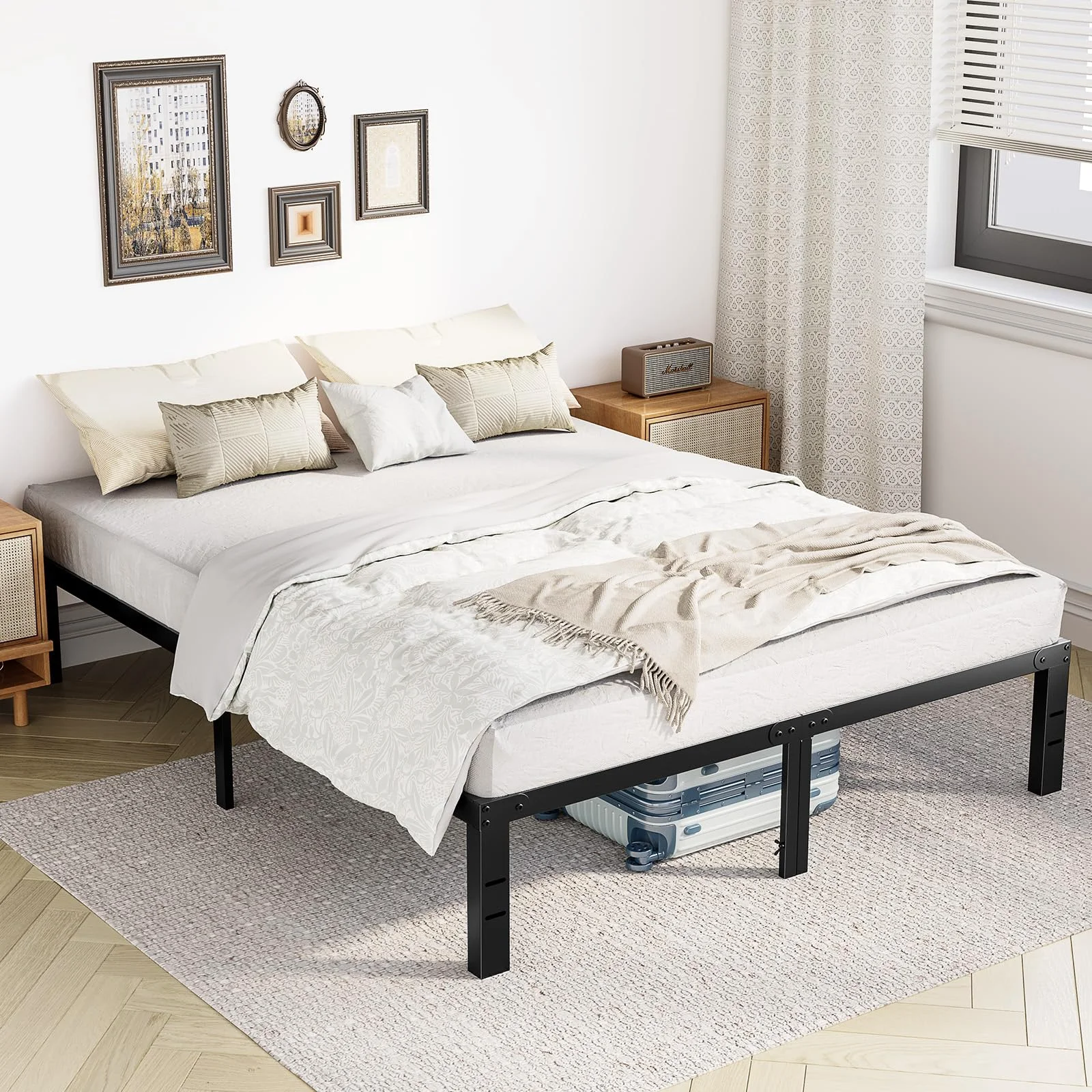
Nobody shops for a bed frame thinking about storage, and everybody lives with the consequences. The space under a bed is the largest continuous storage volume in most bedrooms, and the frame decides whether you can use it.
A platform frame at 14 inches of clearance turns the entire footprint of the bed into a storage floor for flat bins: season clothes, spare bedding, the suitcase family. Steel platform frames also delete the box spring, which is itself a storage decision, one less bulky object that exists only to hold up another object. Slats carry the mattress directly, the frame carries up to its stated rating, and assembly is one person and one included wrench.
Use the under-bed volume for the slow stock, things touched a few times a year, and keep it in lidded bins rather than loose. Loose storage under a bed becomes invisible, and invisible storage becomes a place things go to be lost. Two long shallow bins per side, labeled on the end you can see, and the whole quarterly wardrobe swap takes fifteen minutes.
If the mattress itself is the comfort problem rather than the frame, a topper is the cheap experiment before a new mattress is the expensive one. Ours is three inches of gel-infused memory foam with CertiPUR-US certified foam, and the honest advice is the same we give about chairs: it adjusts comfort, it does not perform medicine, and persistent sleep trouble belongs with a clinician, not a furniture page.
Inside the drawers: the ten-minute system
Storage furniture only works as well as the sorting inside it, and the sorting has to survive tired evenings. Complicated systems die by Thursday. This one is three rules.
Rule one: one category per drawer, named out loud. Shirts. Sleep things. The drawer that holds two categories will hold five by spring, because the second category dissolved the boundary. In a nine-drawer dresser this discipline is cheap, there are enough drawers for every category to live alone, and the spare drawer at the bottom is allowed to be the honest miscellaneous.
Rule two: fold to see edges, not faces. Items filed upright in a drawer, edges up like folders, stay visible all at once, and taking one does not collapse the stack. This matters double in fabric bins, which are deep enough to bury anything laid flat. The upright fold is also self-auditing: the drawer that will not close is telling you about the wardrobe, not about the dresser.
Rule three: the top of the dresser is a display shelf, not a staging area. The moment folded laundry starts landing there on its way to the drawers, the system is a week from failing. Put the tray, the lamp and the photograph there on day one, filling the surface deliberately, and the laundry has to go where it lives.
None of this needs buying anything. It needs the twenty minutes after assembly, while the drawers are still empty and the categories are easy to declare.
When the bedroom borrows from the living room
Small homes blur the line, and the bedroom often hosts furniture the living room could not fit: a TV stand at the foot of the bed, a bookshelf where the reading actually happens, a mirror the hallway had no wall for.
The TV stand question is mostly a height question. Seated in bed, your eye line is lower than on a couch, so a low, wide stand beats a tall unit, and the drawers underneath are legitimate wardrobe overflow, ours take the folded bulky things that fight the dresser, sweaters, throws, the winter layer. Cable management holes in the back panel are the difference between a media corner and a spaghetti exhibit, so use them even when nobody will see.
A bookshelf in the bedroom follows the vertical rule from every small room: a foot and a half of floor buys five shelves of wall. Load it heaviest at the bottom, keep the top shelf light, and if the shelf is tall and the room hosts children, the anchoring paragraph above applies to it word for word. Bookcases are on the CPSC's list of furniture to secure for the same geometric reasons dressers are.
The full-length mirror, finally, is the one piece that makes a small bedroom feel larger while doing an honest job. A floor mirror with a stand needs no drilling and moves with the light, an arched frame softens a room full of rectangles, and placed opposite the window it returns daylight the room already paid for. Just do not park it facing the bed if you are easily startled at 2 a.m. Every mirror owner learns this once.
A weekend plan that actually finishes
Bedroom reorganizations fail by being total. The version that works fits in one weekend and buys its wins in order.
Saturday morning, the bedside. Clear both nightstands to zero, return only the current items to the top, assign the drawer to the small private things, and route the charging cables inside or behind. Saturday afternoon, the wardrobe triage: everything leaving the room leaves now, in bags, before any new storage is assembled. New capacity filled with things you were about to discard is clutter with better packaging.
Sunday morning, assemble and anchor. The dresser goes up, the strap goes on, the drawers get loaded with the survivors of Saturday. Sunday afternoon, the under-bed floor: bins in, labels out, and the vacuum's last pass before the frame swallows the space for a season.
Then stop. A bedroom does not need a storage system with a name. It needs a top layer that stays clear, a middle layer that closes, a bulk layer you can reach twice a year, and a wall that is holding onto the tall furniture. Everything else is decoration, and decoration is allowed, on surfaces that finally have room for it.
Caring for the quiet furniture
Bedroom pieces work daily and get thanked never, and ten minutes a season keeps them out of the replacement cycle. Fabric drawers come out of their frames entirely, so vacuum the bins empty once or twice a year and let the frame's corners get the cloth the rest of the room gets. Steel frames want their bolts snugged after the first month of use and again at the season turn, beds especially, because a frame that squeaks is almost always a frame that loosened, not a frame that failed.
Wood-look tops handle daily life but not standing water, so the glass gets a coaster even in the bedroom, and laminate faces prefer a barely damp cloth to any spray with a shine promise. Drawer runners, fabric or metal, stay smooth if they stay dry. The anti-tip strap gets its own line in the seasonal ten minutes: check the tension, check the wall screw, and re-set it the same day after any furniture move. A strap that was on last year and off this year protects nobody, and re-attaching it costs two minutes of the ten.
None of this is house-proud fussing. It is the difference between furniture that ages and furniture that fails, and cheap pieces maintained beat expensive pieces ignored with room to spare.
Quick answers
How tall should a nightstand be? Within a couple of inches of the top of your mattress, either side. Reaching up beats reaching down, so when in doubt, taller.
Can a fabric dresser hold a full adult wardrobe? Nine drawers hold a season of everything plus the spares in practice. The constraint is not volume but weight per drawer: fold heavy knits flat rather than stacking them high in one bin.
Do I really have to anchor a dresser if there are no kids in the house? The strap also protects the guest with a toddler, the future tenant and you during the earthquake you were not planning. It costs ten minutes, and the kit is already in the box, because the answer is yes.
Is a 14-inch frame too high, or not high enough? With a typical 10 to 12 inch mattress you land at standard seat-and-a-bit height, easy to sit onto and stand from, with a full bin-height storage floor underneath. Lower profiles look sleeker and store nothing. That is the whole trade.
What single change makes the biggest difference? The nightstand reset. It is the surface you see first every morning and last every night, it takes twenty minutes, and it teaches the method the rest of the room will use.
Keep reading
- How to Sit Cross-Legged at a Desk, Comfortably and Without Guilt. What posture guidance actually says, the seat measurements that decide everything, and how to set up a chair for the way you already sit.
- The Small-Space Home Office: Planning a Desk Setup That Fits. Measure three numbers, pick the desk shape from the corner you own, choose the chair second, and put the storage on wheels.
- Or go back to DUMOS desks and the best sellers on the front page.
