You are probably not sitting the way your chair expects right now. One ankle is resting on a knee, or a foot is folded under you, or you have pulled both legs up onto the seat and settled in properly. None of this makes you unusual. It makes you a person, and it is the single most consistent thing we have learned from years of building chairs around it.
Our inbox asks one question more than any other: how do you sit cross-legged at a desk all day without paying for it by evening? The long answer starts with what public health guidance actually says about sitting, moves through the chair measurements that decide whether the position works at all, then the setup that makes the numbers land right, and, honestly, the days when a criss-cross chair is the wrong tool and a supportive high-back is the right one.
What the guidance really says about posture
Start with the surprise: the official advice is less rigid than the diagrams suggest. OSHA's guidance for computer workstations opens by saying there is no single correct posture or arrangement that fits everyone. The recommendations that follow are about relationships, not one frozen pose: head balanced over the torso, shoulders relaxed, elbows close to the body and supported, lower back supported, wrists in line with forearms, feet flat on the floor or on a rest.
MedlinePlus, the National Library of Medicine's plain-language health site, makes the same point from the other direction. Posture is how you hold your body, the key is keeping the spine's three natural curves, and the practical advice is to stay mindful of position during everyday activities, keep moving, and not sit still in any one arrangement for long stretches.
The enemy is not any single position. It is the hour you spend frozen in one.
Notice what that means for cross-legged sitting. The question is not whether the position appears in an ergonomics diagram. The question is whether your setup keeps the useful relationships, a balanced head, supported back, relaxed shoulders, and whether you can change position freely when your body asks. A chair that physically blocks position changes works against the strongest advice in the guidance, movement, no matter how correct it looks in a photograph.
One honest caution belongs here. If any sitting position causes pain, numbness or tingling, the answer is not a better chair, it is your clinician. None of what we write is medical advice, and a chair is not a treatment for anything.
The measurements that decide everything
Whether cross-legged sitting works at a desk comes down to a few numbers. We print them beside our chairs because they matter more than any adjective.
| Measurement | Why it decides | What to look for |
|---|---|---|
| Seat width | Both knees must land on the cushion | 22 inches is workable, 25 to 26 inches is comfortable |
| Armrests | Arms block folded legs at the hip | None, for this position |
| Seat height range | Crossed legs raise your effective height | A gas lift with several inches of travel |
| Seat depth and pan shape | A hard front edge digs into ankles | A flat, padded pan with a rounded edge |
| Base and rating | The load sits differently when you fold up | A five-point base and a stated weight rating |
Seat width is the headline. A standard task chair runs around 18 to 19 inches between the armrests, and an adult simply cannot fold both legs into that space. Our criss-cross line runs wide, just under 26 inches of flat cushion on the widest seat, because the position needs the full landing zone. If you have ever perched cross-legged on a normal office chair with your knees jutting past the edges, you know the difference a real number makes.
Armrests are the quiet dealbreaker. Even generous fixed arms sit exactly where a folded shin wants to be. This is what people mean when they discover that armless is a feature, not an economy.
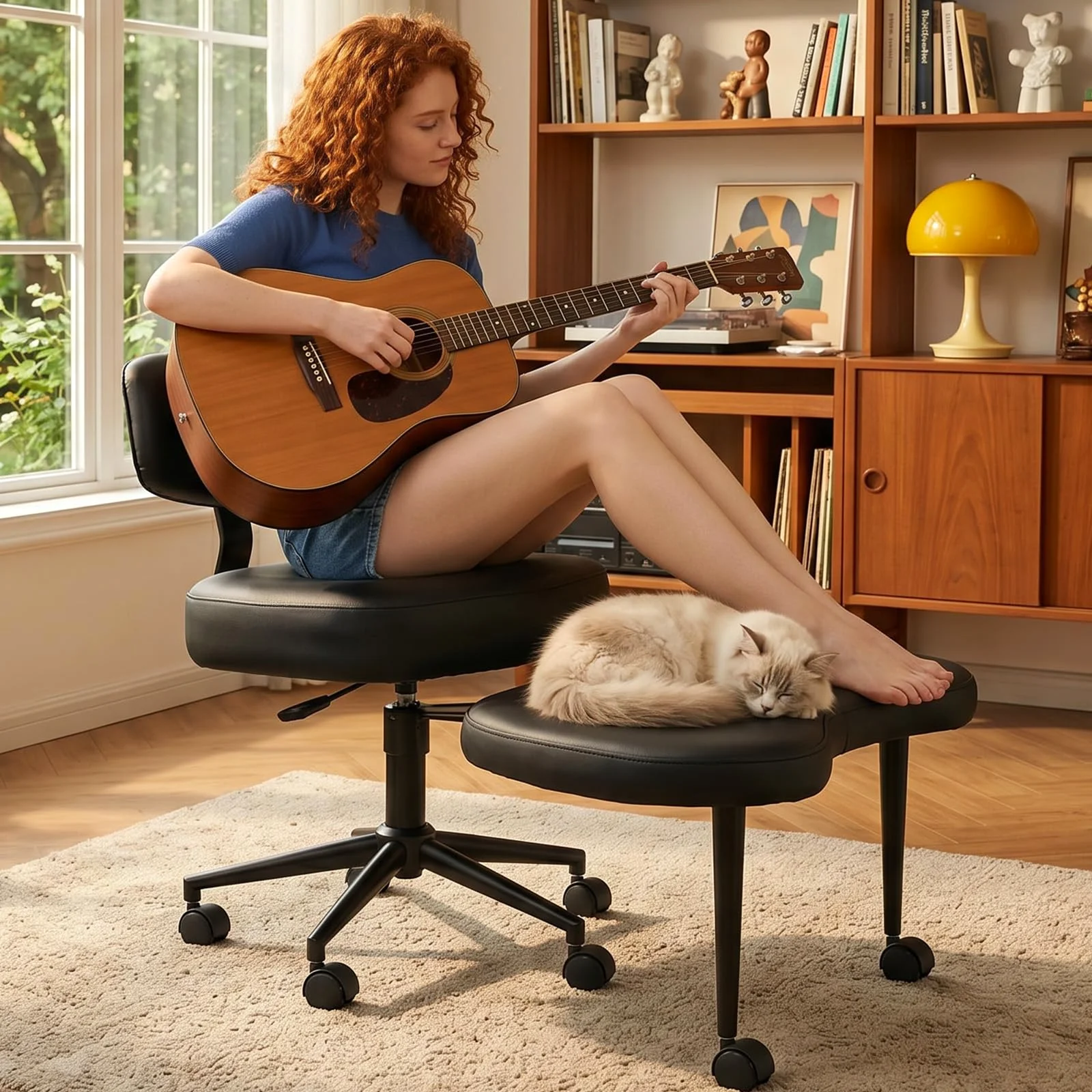
Setting the height when your legs are the cushion
Here is the adjustment almost everyone misses: sitting cross-legged effectively raises you. Your legs fold under you and add their own height, so a seat set correctly for feet-flat sitting is suddenly too high for the same desk, and your shoulders creep up while your wrists bend back.
The fix takes ten seconds. Fold into the position you actually use, then set the lift so your forearms land level with the desk surface, elbows near your body, shoulders down. Mayo Clinic's ergonomics guidance gives the anchor points: arms resting gently, elbows close, and the monitor about an arm's length away with the top of the screen at or slightly below eye level. When you unfold back to feet-flat sitting later in the day, drop the seat back down. The chair moving twice a day is the system working, not a compromise.
Two more details earn their keep. First, clear the space under the desk. Mayo's guidance says plainly not to store things under there, and for cross-legged sitters this doubles: you need room to unfold, and a printer box where your feet land means you will not change position when you should. Second, mind the desk's cross-brace. A low brace that never touches a square sitter's knees can sit exactly at folded-knee height, so check the clearance figure, not just the top size.
A day of positions, not a position
The cross-legged seat earns its keep as the home base in a rotation, not as a new frozen pose. A rhythm that works for many of our buyers looks like this.
| Stretch of the day | Position | Why it works |
|---|---|---|
| Deep-focus morning | Fully cross-legged on the cushion | Stable, compact, keeps you settled |
| Meetings and calls | Feet flat, back against the backrest | The supported posture in every guideline |
| Early afternoon | One leg folded, one foot down | Half-way house, easy to switch from |
| Late afternoon | Perched forward, feet flat | Wakes up a tired lower back |
| Any long stretch | Stand, walk, refill the glass | Movement, the advice every source agrees on |
The pattern is the point. MedlinePlus tells you to keep moving, OSHA declines to crown one posture. A wide flat seat is what makes the rotation cheap: no arms to climb over, no bolster in the way, nothing to renegotiate each time. You just move, and the chair does not argue.
If you catch yourself locked in any one arrangement for over an hour, treat it the way you would treat a numb foot: as a signal, not a virtue. Stand up, unfold and reset the seat height if you have changed base position.
Choosing between the criss-cross chairs we build
Because the question lands in our inbox weekly: the criss-cross line has a few members, and they differ in exactly three ways that matter. Everything else is upholstery.
Wheels or none. The wheeled versions roll on a five-point base with a gas lift, behave like any task chair, and suit a hard floor or a chair mat. The no-wheels version stands on four steady legs and swivels on its seat, and it exists for the people who found out the hard way that a wheeled chair on a smooth floor migrates while you are folded up on it. Cross-legged sitting moves your center of weight around more than square sitting does, and legged stability is the calmer platform for it. On carpet the difference shrinks and either works.
Fabric or PU leather. Woven fabric breathes better and forgives claws and buckles, and it is the default choice for a chair your bare ankles will rest on all day. PU leather wipes clean in one pass, which makes it the parent's choice and the snacker's choice, and it reads dressier at a vanity. Neither survives a cat that has made a decision, and we would be lying if any brand told you otherwise.
Seat height range. The wide seats are deeper than standard chairs, so check the lift range against your desk rather than assuming. Folded legs add height, square sitting takes it back, and the chair has to cover both of your positions under the same desk. The figures are printed per piece on the front page, and this is exactly the case where the printed figure beats the photograph.
If the choice is still a coin flip after those three, take the version whose cover you will still like in year three. The mechanics are siblings. The cover is the thing you touch every day.
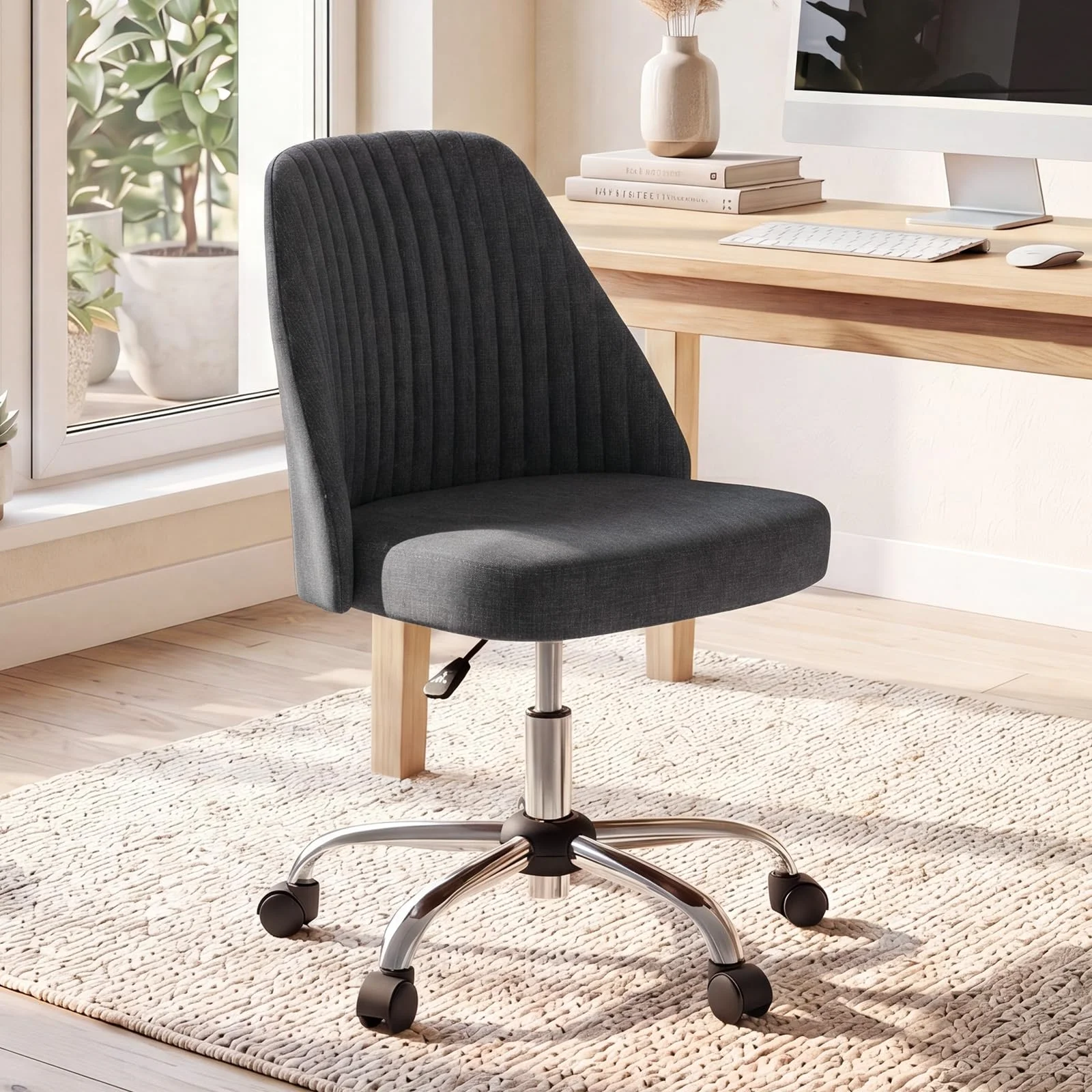
Building the habit: the first two weeks
A wide chair permits better sitting. It does not install it. The people who get the most out of the switch treat the first two weeks as calibration, and their letters describe the same small sequence.
Days one and two are honeymoon: the novelty of folding up legally at a desk carries everything. Days three to five are where the old habit fights back, usually as one particular position you hold too long because it finally feels good. This is when the hourly reset earns its keep. Stand when you notice you have gone still, unfold, and re-set the seat height if you changed base position. A phone timer is not embarrassing. Sitting frozen for three hours is.
By the second week, most people report the thing the guidance predicted: the rotation becomes automatic, cross-legged for focus, feet-flat with back support for calls, perched for the afternoon slump, and the chair stops being a topic. That is the goal. A chair you think about all day is a chair that fits badly, and the whole point of buying for your real sitting style is to stop negotiating with your furniture.
Two setup mistakes surface in almost every difficult first week, so check them before blaming the chair. A desk too tall for the raised cross-legged position forces shoulders up, and the fix is lowering the desk or raising the screen, not abandoning the position. And a seat set for the folded height but never lowered again turns feet-flat sitting into a dangle, which the backs of your thighs will report by Friday. The chair moving with you is the system. The chair parked at one height is only half of it.
The days this is the wrong chair
We build wide armless chairs on purpose, so believe us when we say they are not always the answer. An armless design gives your upper body nothing to lean on, and there are days that matters more than freedom.
If your work is long back-to-back video calls where you barely move, a high-back chair with lumbar support and adjustable arms will serve you better, and that is exactly what our ergonomic room is for. If you already deal with back trouble that flares without lumbar support, start with the supportive chair, not the wide one. If your desk is high and fixed, check that the chair's lift reaches the height your forearms need before falling for any seat, wide or narrow.
The right chair is the one that fits your worst hour, not your best photograph.
Plenty of our buyers own the pair: a criss-cross chair at the personal desk, a supported chair for the marathon days, and the room decides which one rolls forward. Chairs are cheaper than physiotherapy, and both kinds together still cost less than one throne.
Keeping the chair good for years
A criss-cross chair carries its load differently, weight concentrated mid-cushion rather than spread to the edges, so a little care goes further than usual.
Check the stated weight rating before buying, remembering it describes the piece as designed, seat loaded, base on its wheels or legs. Give the seat a quarter turn now and then if you always fold the same way, so the foam wears evenly. Vacuum fabric seats and wipe PU leather with a barely damp cloth, and keep solvents away from both. Twice a year, flip the chair and snug the base bolts, because every well-used chair loosens a little and a wobble caught early never becomes a creak.
Nothing on that list takes ten minutes, and a seat with high-density foam repays it by still being the same chair in year three.
What the wide seat changes at the desk itself
One consequence of a wide armless chair surprises people: it changes what the desk needs to be. Armrests are the usual reason a chair will not slide under a desk, so removing them frees the shallow desks small rooms depend on. A seat nearly 26 inches wide still needs its lateral room though, so measure the gap between desk legs or drawer pedestals before assuming the chair tucks between them.
The other change is reach. Folded up, you sit a touch taller and a touch further back on the seat pan, so the keyboard wants to come toward you rather than you toward it. Pull the keyboard to the front third of the desk, park the mouse beside it, and let the empty back half of the desk hold the screen at its arm's length. On the guidance numbers, nothing changes, elbows near the body, wrists straight, screen top at or below eye level. The furniture just has to move a few inches to keep those numbers true in the new position.
If your desk has a fixed keyboard tray, test it against the folded position specifically. Trays hang below the desktop, exactly where a folded knee wants to be, and this single collision explains most of the rare letters we get from unhappy cross-legged sitters. The flat-topped desk, tray-free, is the natural partner for this whole category of chair.
Quick answers
Is sitting cross-legged at a desk bad for you? The guidance does not blacklist positions, it warns against stillness and lost alignment. Keep the spine's curves, support what needs supporting, move often, and see a clinician about pain rather than a furniture page.
What seat width do I actually need? Most adults fold comfortably from about 22 inches, and are properly comfortable at 25 to 26. Below 20 inches the position stops being restful and starts being a perch.
Why armless, really? Because armrests occupy the exact space folded legs need, and because sliding fully under a small desk is the other thing narrow rooms require. Two problems, one subtraction.
Does the position change the chair I should buy for someone else? Ask how they sit when nobody designed for it. A person who folds up belongs in the wide room of the catalog. A person who wants to lean back and be held belongs in the supported one. The honest gift is the one that matches the habit.
Keep reading
- The Small-Space Home Office: Planning a Desk Setup That Fits. Measure three numbers, pick the desk shape from the corner you own, choose the chair second, and put the storage on wheels.
- Bedroom Storage That Works: Nightstands, Dressers and the Wall. Sizing a nightstand honestly, what fabric drawers trade, why bed height is a storage decision, and the ten-minute anchoring job that finishes a dresser.
- Or go back to DUMOS chairs and the best sellers on the front page.
